Ser vs estar: how to choose, with 30 examples
By Tarek Sahyoun ·

Spanish has two verbs for "to be", and choosing the wrong one is the mistake learners make most. The good news: one question settles most cases.
| Use | Ser | Estar |
|---|---|---|
| What it is / how it is | identity, type, traits | state, mood, condition |
| Place | where an event happens | where a person or thing is |
| Time | hours, days, dates | — |
| With -ando / -iendo | — | actions in progress |
| Example | Es médico. | Está cansado. |
I got this wrong for months. I'd tell people "soy cansado" after work, and nobody corrected me because they understood anyway. That's the trap: ser vs estar mistakes rarely stop a conversation, so they stick.
The one question
Ask yourself: am I saying what something is, or how or where it is? What something is (its identity, type, origin, time) takes ser. How it is right now, or where it is, takes estar.
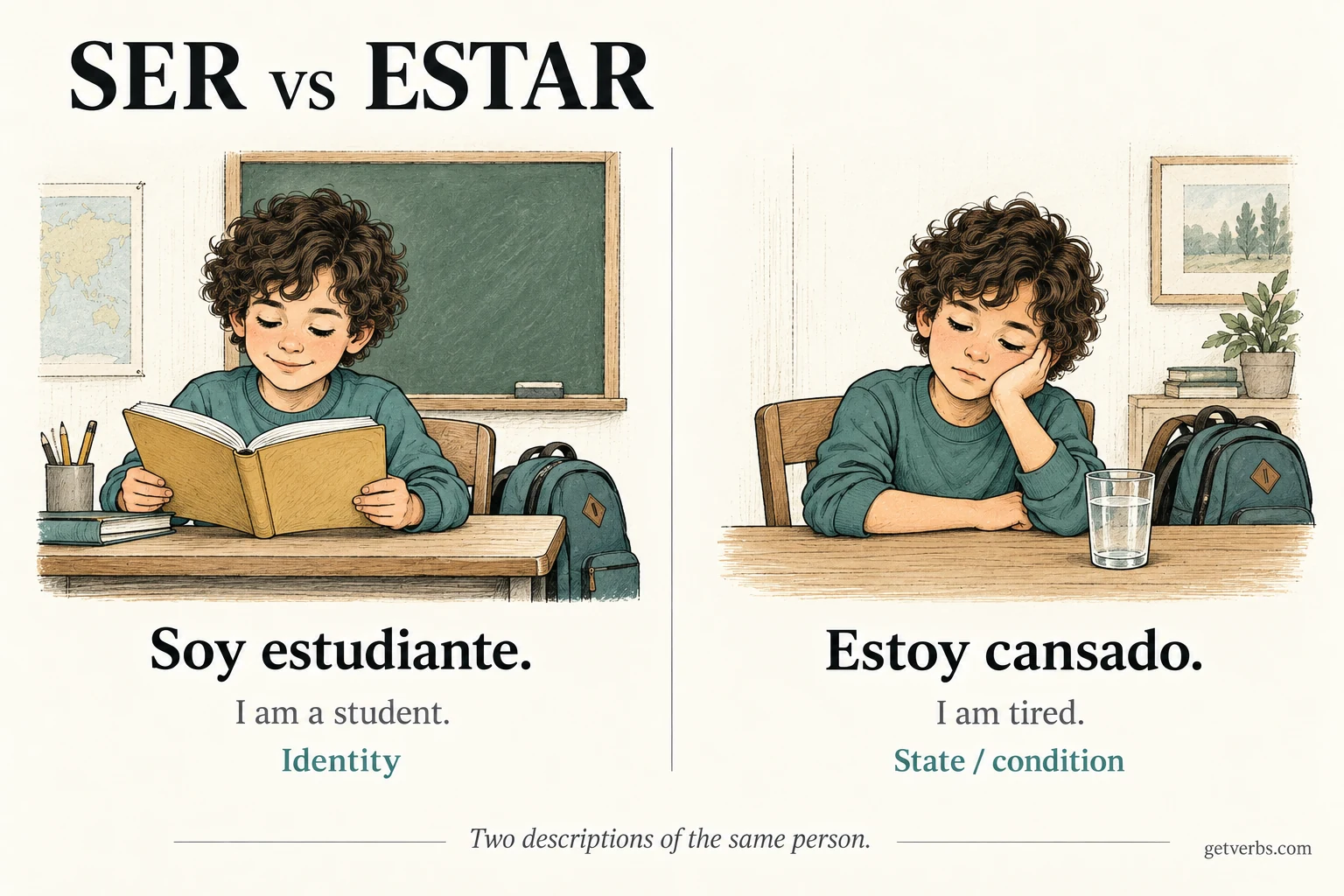
“Soy estudiante” means “I am a student”: ser identifies the child as a student. “Estoy cansado” means “I am tired”: estar describes how the same child feels. Being a student can change too; this is not a permanent-versus-temporary rule.
View full-size illustration (opens in a new tab)Use ser for what something is
- Identity and job: who or what someone is.
- Origin and material: where it's from, what it's made of.
- Time and dates: the hour, the day.
- Lasting traits: what something is like by nature.
- Where an event takes place.
Soy profesora.I'm a teacher.
Somos de México.We're from Mexico.
La mesa es de madera.The table is made of wood.
Son las tres.It's three o'clock.
Hoy es lunes.Today is Monday.
Mi hermano es alto.My brother is tall.
Eres muy simpático.You're very friendly.
La fiesta es en mi casa.The party is at my house.
Fue un día largo.It was a long day.
Era médico.He was a doctor.
Use estar for how or where something is
- Location of people and things.
- Moods and feelings.
- Temporary states and conditions.
- Ongoing actions, with the gerund (estar + -ando / -iendo).
Estoy en casa.I'm at home.
Madrid está en España.Madrid is in Spain.
¿Estás cansado?Are you tired?
Estamos contentos.We're happy.
La sopa está fría.The soup is cold.
La puerta está abierta.The door is open.
Están comiendo.They're eating.
Estuve enfermo toda la semana.I was sick all week.
Estaba nerviosa.She was nervous.
Está muerto.He's dead.
Words that change meaning
Some adjectives mean something different with each verb. "Es aburrido" means he's boring; "está aburrido" means he's bored. "Es listo" means clever; "está listo" means ready. "Es rico" is rich; "está rico" is tasty.
The pair that finally made it click for me was es rico / está rico. Telling a cook their food "es rica" sounds like you're commenting on their bank account. Once that joke landed, I stopped mixing them up.
Two traps
Location of things uses estar, but the place where an event happens uses ser: "el concierto es en el parque". And death uses estar ("está muerto") even though it's permanent, because Spanish treats it as a resulting state.
Ser and estar in the past
The same rule works in every tense. For ser in the past, the imperfect (era) describes what someone or something was like, and the preterite (fue) sums up an event as a whole. Estar follows the usual split between the imperfect (estaba, a state in the background) and the preterite (estuve, a state with clear limits).
La casa era muy bonita.The house was very pretty.
La boda fue en junio.The wedding was in June.
Estábamos en la playa cuando empezó a llover.We were at the beach when it started to rain.
Estuvimos dos semanas en Perú.We were in Peru for two weeks.
Describing people: the hardest case
With adjectives, ask whether you're describing what the person is like or how they seem right now. "Ana es guapa" says she's an attractive person. "Ana está guapa" says she looks good today, perhaps in a new outfit. Both are correct; they just say different things.
Mi abuela es muy joven para su edad.My grandmother is very young for her age.
¡Qué delgado estás!You look so thin!
Marital status can go either way. "Es casado" and "está casado" are both heard, but "está casado" is far more common in everyday speech.
Ser and estar with the past participle
Ser + participle describes an action done by someone (the passive): "La carta fue escrita por mi padre" (the letter was written by my father). Estar + participle describes the state that results: "La carta está escrita" (the letter is written, it's finished). In conversation, Spanish speakers use the passive with ser far less than English does.
A quick check you can use
- Could you replace it with "is located"? Use estar (unless it's an event).
- Is it a job, a nationality, a time or what something is made of? Use ser.
- Is it a feeling or how something seems right now? Use estar.
- Is the verb followed by an -ando or -iendo form? Use estar.
Common mistakes
Soy cansado.→ Estoy cansado.Tiredness is a temporary state, so it takes estar.
La fiesta está en mi casa.→ La fiesta es en mi casa.Where an event takes place uses ser.
Estoy profesor.→ Soy profesor.Jobs are part of who you are, so they take ser.
Es muy rico este pastel.→ Está muy rico este pastel."Tasty" describes how food is right now: estar rico. "Es rico" means wealthy.
Mi hermano está alto.→ Mi hermano es alto.Height is a lasting trait. "Está alto" only works for a child who has grown a lot.
More everyday examples
¿De dónde eres?Where are you from?
¿Cómo estás?How are you?
El examen es mañana.The exam is tomorrow.
Estoy de vacaciones.I'm on holiday.
Es la una y media.It's half past one.
El café está caliente.The coffee is hot.
One honest note: the "permanent vs temporary" rule you'll see everywhere caused me more trouble than it solved. Está muerto and es joven break it straight away. The "what it is vs how or where it is" question above is the one I actually use.
Test yourself
- Mi hermana ___ enfermera. (ser / estar)
Show answer
es: a job is identity. - ¿Dónde ___ las llaves?
Show answer
están: location of things. - La reunión ___ en la sala 3.
Show answer
es: the place where an event happens. - Hoy yo ___ muy cansada. (present)
Show answer
estoy: a temporary state. - Ayer ___ jueves.
Show answer
fue: days and dates use ser. - El concierto ___ en el estadio.
Show answer
es: an event's location takes ser. - Esta paella ___ buenísima.
Show answer
está: how food tastes right now. - Nosotros ___ estudiantes.
Show answer
somos: identity.
Keep going
Tense lessons: Present, Preterite, Imperfect
Practice estar