Por vs para: when to use each, with simple rules
Por and para can both mean "for". A simple way to choose: para points to a goal, por looks at the cause, the route or the exchange. With examples and a quiz.
By Tarek Sahyoun, learning Spanish and sharing notes
In short
- Both por and para can mean "for" in English.
- Para points forward: a goal, a person who receives something, a deadline, a destination.
- Por looks back or through: a reason, a route, an exchange, a length of time.
- If you can say "in order to" or "for the purpose of", you almost always need para.
English uses one word, for, where Spanish uses two. The good news: one picture settles most cases.
The one picture
Picture an arrow. Para is the arrow's tip: where something is headed. Por is what's behind or along the arrow: why it started, or the path it takes.
- Goal, purpose, receiver, destination, deadline: para.
- Reason, route, exchange, duration, means: por.
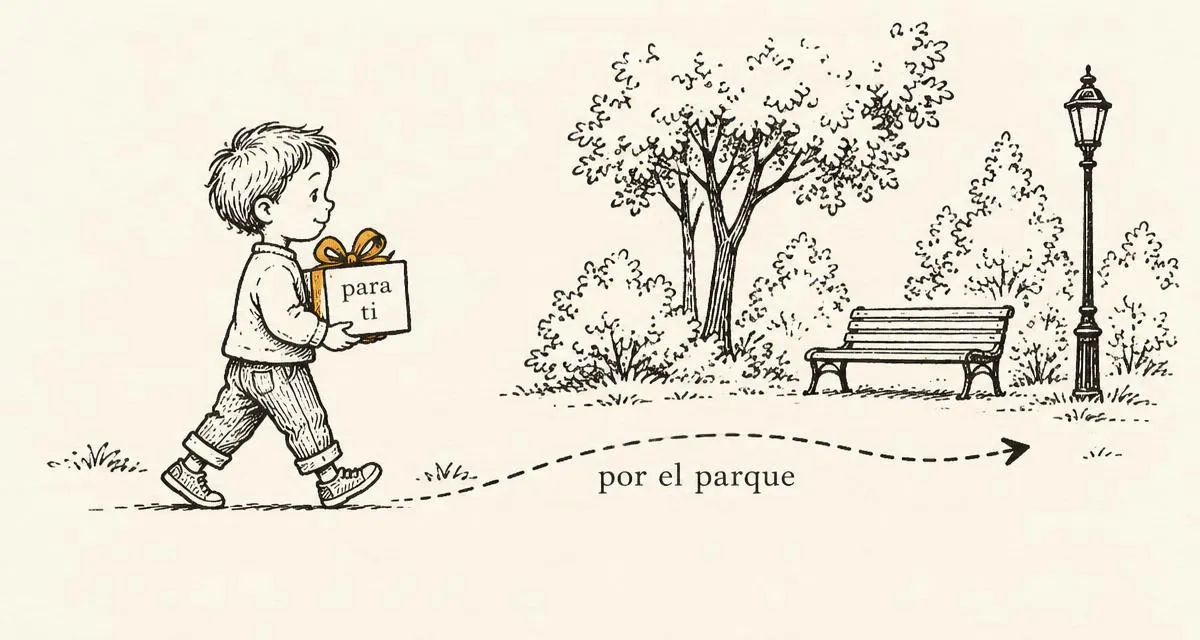
Este regalo es para ti.This gift is for you. (you receive it)
Gracias por el regalo.Thanks for the gift. (the gift is the reason)
When to use para
| Use | Example | English |
|---|---|---|
| Purpose (in order to) | Estudio para aprender. | I study in order to learn. |
| Receiver | La carta es para Ana. | The letter is for Ana. |
| Destination | Salimos para Madrid. | We're leaving for Madrid. |
| Deadline | Lo necesito para el lunes. | I need it by Monday. |
| Opinion | Para mí, es fácil. | For me, it's easy. |
| Comparison | Para un niño, lee muy bien. | For a child, he reads very well. |
When to use por
| Use | Example | English |
|---|---|---|
| Reason or cause | Gracias por tu ayuda. | Thanks for your help. |
| Movement through | Caminamos por el parque. | We walked through the park. |
| Exchange or price | Lo compré por diez euros. | I bought it for ten euros. |
| Length of time | Viví allí por dos años. | I lived there for two years. |
| Means | Hablamos por teléfono. | We talked on the phone. |
| Per | Dos veces por semana. | Twice a week. |
Same sentence, different meaning
Sometimes both are correct, and the choice changes the meaning:
- Trabajo para mi padre. I work for my father (he's my boss).
- Trabajo por mi padre. I work in place of my father, or because of him.
- Lo hice para ti. I did it for you (as a gift or to help you).
- Lo hice por ti. I did it because of you (you were the reason).
Common mistakes
Gracias para todo.→ Gracias por todo.You thank someone because of something: that's a reason, so por.
Estudio por aprender.→ Estudio para aprender."In order to" is a goal, so para.
Lo compré para diez euros.→ Lo compré por diez euros.Money given in exchange takes por.
Fixed phrases with por
Some phrases you simply learn as a block: por favor (please), por eso (that's why), por fin (finally), por ejemplo (for example), por supuesto (of course), por la mañana (in the morning).
Remember
- Para = the goal or the receiver.
- Por = the reason, the route or the exchange.
- Gracias por, por favor, por eso are always por.
Test yourself
- Este café es ___ ti.
Show answer
para - Gracias ___ venir.
Show answer
por - Caminamos ___ la playa.
Show answer
por - Necesito el informe ___ mañana.
Show answer
para - Lo vendí ___ cien dólares.
Show answer
por - Ahorro dinero ___ viajar.
Show answer
para
Keep going
Verb tables:
Tense lessons: